






I am the head of the Smart Sense, a research group that investigates problems related to Video Surveillance, Forensics and Biometrics by developing techniques on Computer Vision, Pattern Recognition and Digital Image Processing. The Smart Sense research group is located at the Uncertainty in Artificial Intelligence Laboratory (LabUAI) which is composed of researchers, graduate and undergraduate students.
My research includes the development of techniques for Computer Vision, Machine Learning and Image Processing to solve problems on three main application domains: Smart Surveillance, Biometrics and Computer Forensics. I tend to investigate these problems in an integrated manner. While surveillance aims at “discovering” possible suspicious activities that can lead to an undesired event, the computer forensics searches for evidences once the event already took place in an earlier time. The biometrics is important for both because being able to identify the agents in the video might lead to different conclusions regarding the importance of the activities executed.

Projects
Over the years, I have coordinated several research projects in the areas of Computer Vision and Pattern Recognition applied to Smart Surveillance, Biometrics and Computer Forensics. Some of the projects have been sponsored by Brazilian Research Funding Agencies, such as the Brazilian National Research Council (CNPq), the Minas Gerais Research Foundation (FAPEMIG) and the Coordination for the Improvement of Higher Education Personnel (CAPES).
Besides the research projects, the group also conduct several R&D projects in partnership with large companies, those focusing on smart surveillance, video analytics and processing of signals captured by wearable devices.
Publications
I published many scientific papers focusing on computer vision, smart surveillance, biometrics and computer forensics in important conferences and journals, such as ICCV, ECCV, BMVC, WACV, ICIP, ICASSP, FG, IEEE Transactions on Image Processing, IEEE Transactions on Information Forensics and Security, Elsevier Neurocomputing and a book on Image Processing. For a complete list of publication, check my Google Scholar profile.
Academic Services
Associate Editor
2023-present | Computer Vision and Image Understanding
2019-2024 | IEEE Transactions on Information Forensics and Security
Area Chair
2026- | European Conference on Computer Vision (ECCV)
2024-present | IEEE/CVF Conference on Computer Vision and Pattern Recognition (CVPR)
2022-present | IEEE/CVF Winter Conference on Applications of Computer Vision (WACV)
Graduate Program Coordinator
2020-2023 | Coordinator of the Graduate Program in Computer Science at Federal University of Minas Gerais
Program Chair
2016 | SIBGRAPI – Conference on Graphics, Patterns and Images
Awards
Dissertation Honorable Mention
2021 - Advisor of work Partial Least Squares: A Deep Space Odyssey. Honorable Mention in the Great PhD Dissertation Prize at Federal University of Minas Gerais. Student Artur Jordão Lima Correia
Best Thesis Award
2018 - Advisor of work Face Recognition Based on a Collection of Binary Classifiers. Best Thesis on the Workshop of Thesis and Dissertation in SIBGRAPI – 31st Conference on Graphics, Patterns and Images. Student Rafael Vareto.
IAPR/IEEE Best Paper Runner-up Award
2017 - IAPR/IEEE Best Paper Runner-up Award with paper Towards Open-Set Face Recognition using Hashing Functions, International Joint Conference on Biometrics (IJCB 2017)
Best Paper Award
2017 - Best Computer Vision/Image Processing/Pattern Recognition Main Track Paper Award with paper Activity Recognition Based on a Magnitude-Orientation Stream Network, SIBGRAPI 2017 – 30th Conference on Graphics, Patterns and Images.
Nomination for the Tortoise Prize
2008 - Selected among 10 finalists for the Jabuti Award (Tortoise Prize), category Exact Sciences, Technology and Informatics with the book Analise de Imagens Digitais: Principios, Algoritmos e Aplicacoes (Analysis of Digital Images: Principles, Algorithms and Applications).
To provide a functional environment and to capture video and images to perform computational experiments, my group has access to a set of state of the art computer servers, desktops, laptops, network equipment, several IP cameras (fixed, PTZ, fish-eye) and others. These equipment were acquired thank to the support received from FAPEMIG, CNPq, CAPES, UFMG, NVIDIA and private companies. Our main processing servers are the following.
Processing
10 Servers + 1 Control unit
46 GPUs / 428 CPU cores / 2.03 TB RAM
Nvidia L40, A100, GTX 1080
Cluster management (Slurm)
Storage
2 Storage servers (QNAP Systems)
240 TB Disk (16x12TB + 12x4TB SATA HDDs)
Data storage manager (Qnap QTS)
My group is composed of researchers, graduate and undergraduate students that investigate problems related to Video Surveillance, Forensics and Biometrics by developing techniques on Computer Vision, Pattern Recognition and Digital Image Processing.
Current Students
PhD Students
Ana Paula Schiavon Yamada
Eliamara Souza da Silva
Maiko Min Ian Lie
Rafael Henrique Vareto
MSc Students
Breno Augusto Mariano
João Victor Chaves de Castro
Luiz Guilherme Fonseca Carreira
Mardem Arantes de Castro
Pedro Lucas Aiala dos Santos
Former Students
PhD Students
Artur Jordão Lima Correia
Carlos Antônio Caetano Júnior
Igor Leonardo Oliveira Bastos
Jéssica Sena de Souza
Marco Túlio Alves Rodrigues
Raphael Felipe de Carvalho Prates
Renan Oliveira Reis
Rensso Victor Hugo Mora Colque
MSc Students
Antônio Carlos Nazaré Júnior
Artur Jordão Lima Correia
Cássio Elisa dos Santos Júnior
Cristianne Rodrigues Santos Dutra
Gabriel Resende Gonçalves
Guilherme Cramer
Jesimon Barreto Santos
Jéssica Sena de Souza
Luiz Eduardo Lima Coelho
Matheus Alvez Diniz
Rafael Henrique Vareto
Renato Lopes Júnior
Ricardo Barbosa Kloss
Samira Santos da Silva
Victor Hugo Cunha de Melo
Vitor Cezar de Lima
MoRe: A Large-Scale Motorcycle Re-Identification Dataset
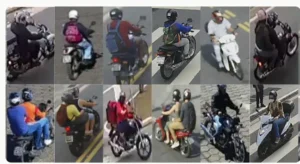
Motorcycle Re-Identification (MoRe) dataset, is the first large-scale motorcycle ReID database captured by urban traffic cameras. Precisely, MoRe contains 3,827 distinct identities and 3,478 distractors captured by ten surveillance cameras.
All documents and papers that report on research that uses this database must acknowledge the use of the database by citing the following reference:
A. M. Figueiredo, J. Brayan, R. O. Reis, R. Prates, W. R. Schwartz. MoRe: A Large-Scale Motorcycle Re-Identification Dataset. Proceedings of 2021 IEEE Winter Conference on Applications of Computer Vision, 2021.
The SWAX Benchmark

The SWAX Benchmark The Sense Wax Attack (SWAX) Database comprises images of real persons and their corresponding realistic wax-made sculptures.
All documents and papers that report on research that
uses this database must acknowledge the use of the database by citing the following reference:
R. H. Vareto, A. Marcia Saldanha and W. R. Schwartz. The Swax Benchmark: Attacking Biometric Systems with Wax Figures. 2020 IEEE International Conference on Acoustics, Speech and Signal Processing
Sense-ALPR Database
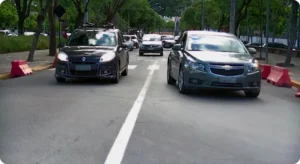
This dataset, called the Sense-ALPR Database, was created to assist researchers in evaluating automatic license plate recognition problems. The data for the article Real-Time Automatic License Plate Recognition Through Multi-Task Networks was captured during the day using two cameras: one placed statically while recording passing vehicles and another placed inside of a vehicle that registered as the vehicle moved through the city.
All documents and papers that report on research that
uses this database must acknowledge the use of the database by citing the following reference:
G. R. Gonçalves, M. A. Diniz, R. Laroca, D. Menotti, W. R. Schwartz. Real-time Automatic License Plate Recognition Through Deep MultiTask Networks. Proceedings of 31st Conference on Graphics, Patterns and Images, 2018.
ETHZ Dataset for Appearance-Based Modeling
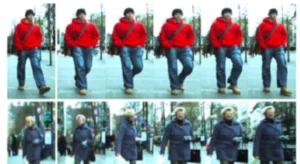 This dataset, called the Sense-ALPR Database, was created to assist researchers in evaluating automatic license plate recognition problems. The data for the article Real-Time Automatic License Plate Recognition Through Multi-Task Networks was captured during the day using two cameras: one placed statically while recording passing vehicles and another placed inside of a vehicle that registered as the vehicle moved through the city.